


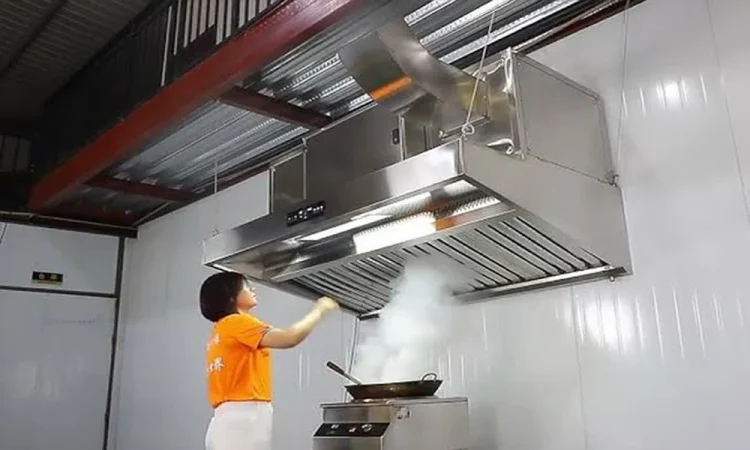
Changing a restaurant’s cooking process does not necessarily move its hood or alter its duct, but it can change the duty that the existing ecology unit was selected to handle. Revisit the original assumptions. Longer service, different appliances or more intensive frying can make the original design inputs worth reviewing before recurring exhaust problems are treated as isolated maintenance faults.
Electrostatic precipitation, UV-C and activated carbon address different parts of the exhaust load. Polygee’s technical guide ties maintenance and configuration to the cooking process, operating hours and airflow. Reviewing a menu change means checking those assumptions together, without inventing a universal extraction rate or deciding in advance that all the equipment must be replaced.
Record what changed in the kitchen’s actual operation
Describe the operation before and after the change. A menu name is less useful than the cooking methods, appliances in use and service pattern, because the equipment supplier needs to understand what now enters the extraction system rather than simply whether the restaurant has rebranded.
Separate simultaneous changes. Longer opening hours, a new appliance and revised cleaning arrangements may occur together, but each changes a different part of the operating picture. Writing down the comparison helps the project team avoid attributing every new complaint to whichever change is most obvious.
Polygee’s explanation of an ecology unit calls for configuration and maintenance based on the kitchen described. Preserve that original description, then identify which parts remain true and which need reassessment.
Keep this review factual. Documenting a change does not establish that the existing unit is undersized, nor that an altered menu automatically requires a different treatment technology. It identifies the questions that the responsible designer and supplier need to answer.
Recheck capture and airflow before changing treatment
Start upstream of the cabinet. The hood must capture the cooking plume before downstream treatment can act on it, so a review should distinguish emissions escaping into the kitchen from a problem at the outside discharge. Those observations lead to different investigations.
The ecology guide states that module sizing follows extract airflow rather than kitchen floor area. A kitchen’s footprint may remain unchanged while its appliances or operating duty change. Ask the ventilation designer to confirm the relevant airflow instead of assigning a new rate from a generic menu category.
Retain the measurement or design basis. If the revised operation requires a different duty, that becomes an input to the equipment review and fan assessment; if it does not, the team still needs to consider whether the contaminant load and maintenance demands have changed at the same airflow.
Assess particle collection against the revised duty
Electrostatic precipitation collects cooking particles on washable cells. Polygee’s LK-E family offers different engineering tiers, with E0 published at 4,000-40,000 m³/h and E1 and E2 at 3,000-24,000 m³/h. These are product ranges, not extraction requirements for particular cuisines.
Ask about the existing model first. Its identification, condition and original selection basis are more useful than a general assumption that a higher tier will solve every changed-duty problem. Confirm whether the proposed operation is within the arrangement the supplier is prepared to support.
The same page labels E0, E1 and E2 at at least 90%, 95% and 98% design efficiency respectively. Those descriptions should remain design ratings. They cannot be presented as measured performance for the restaurant’s revised operation without the relevant evidence.
Check upkeep alongside selection. A collector that has not received the specified service may need that condition addressed before its apparent performance is used to justify replacing it. Record what was found rather than assuming the menu change is the only cause.
Revisit gas-phase treatment instead of relying on a clear plume
The UV-C page asks about cooking style, airflow and duct layout when configuring the system. Its standard range covers 3,000-15,000 m³/h. A collector selected from a wider airflow range does not establish that the existing downstream UV arrangement remains appropriate.
Activated carbon is a gas-phase adsorption stage rather than a replacement for particle collection. The supplier links media replacement to cooking load and odor intensity, with the selected media and fill weight confirmed for the project. A revised duty may therefore require review of the consumable plan even where the cabinet stays.
The U.S. Environmental Protection Agency’s general explanation of industrial carbon adsorption distinguishes breakthrough from complete saturation. That distinction explains why available media capacity should not be assumed from appearance alone. It is background about adsorption, not a performance test or replacement schedule for this kitchen equipment.
Check the whole proposed configuration if airflow changes
Follow the complete treatment path. Changing an airflow input affects the review of each included stage and the fan, not just the collector’s catalog selection. Any proposed addition should be considered as part of the installed system rather than as a box that can be assessed in isolation.
Polygee publishes electrostatic-stage resistance of 23 Pa for E1, 31 Pa for E0 and 34 Pa for E2. Its instructions also require consideration of downstream UV-C and activated carbon modules, ductwork and any distribution plate in fan selection.
Obtain values for the accepted configuration. A cell or stage value cannot stand in for a full treatment-train allowance, and a larger nominal-airflow label cannot show that an existing fan will deliver the required duty after changes. Assign that review to the responsible ventilation professional.
A different arrangement may be needed, but do not invent a standard parallel layout from the catalog ranges. The project team must resolve the actual distribution, connection and treatment requirements before ordering modifications.
Revise service assumptions before establishing new intervals
The ecology guide distinguishes washed collector cells, replacement UV-C lamps and replacement activated carbon media. These tasks follow different service bases. A menu review should therefore identify which schedule changes, rather than applying a shorter blanket interval to the entire train without explanation.
Identify the evidence behind the revision. The supplier and service contractor need the changed duty, observations and maintenance history to propose a suitable plan. Keep the agreed basis with the schedule so future staff understand why it differs from the original handover.
Allow the operator to carry it out. More frequent maintenance can affect access, staff availability and replacement stock, so those provisions need attention alongside the revised calendar. A schedule that is technically appropriate but routinely missed will not sustain the conditions assumed in the review.
Compare operation under recorded conditions
Agree how the revised arrangement will be checked. The menu, appliances operating, extraction setting and maintenance condition should accompany the observations, especially where the change was introduced to address a particular discharge concern.
Observe the relevant location. A clear-looking outlet does not settle an odor complaint at an occupied space, while a subjective odor observation is not a formal emissions test. The type of evidence should match the question being asked and any applicable project requirements.
Keep the original baseline available. A new record can show what changed without erasing the earlier condition, helping the team distinguish the effects of maintenance, equipment alterations and operating duty. Where the result remains uncertain, record that uncertainty and the next investigation.
Close the change review with an accepted operating basis
The useful outcome is a revised basis for operation, whether the equipment stays or changes. Record the decisions and assign responsibility for actions that remain before the kitchen adopts the arrangement as normal practice.
- Describe the changed cooking methods and service pattern.
- Confirm the capture and airflow basis with the responsible designer.
- Review particle and gas-phase stages at that duty.
- Update the maintenance and consumable arrangements where needed.
- Retain observations made under the revised operating conditions.
An ecology unit review after a menu change is a check of assumptions, not an automatic replacement exercise. The kitchen may retain useful equipment, revise its service plan or need a different configuration. Connecting those decisions to the actual cooking duty produces a more defensible outcome than treating an unchanged building footprint as proof that nothing needs reviewing.
A Guide to Bozeman Taprooms for Food, Beer and a Night Out

You want a taproom plan that delivers great beer, real food, and a relaxed night with friends. I study taprooms...

Restaurants on the Costa del Sol: where to eat along Spain’s sunny southern coast

Most people arrive on the Costa del Sol expecting beach bars, sangria and tourist menus. And yes, all of that...

Polynesian Fire Luau Myrtle Beach: Show Details, Menu, and Visitor Reviews


What Is Polynesian Fire Luau in Myrtle Beach? Polynesian Fire Luau is a unique dinner theatre experience in Myrtle Beach,...

Comparing Spray Drying and Freeze Drying for Food Production
In the food industry, dehydration is a critical process for extending shelf life, reducing storage costs, and creating convenient products.Among...